By Blim · Last updated: October 7, 2026 · Sources: IRS.gov
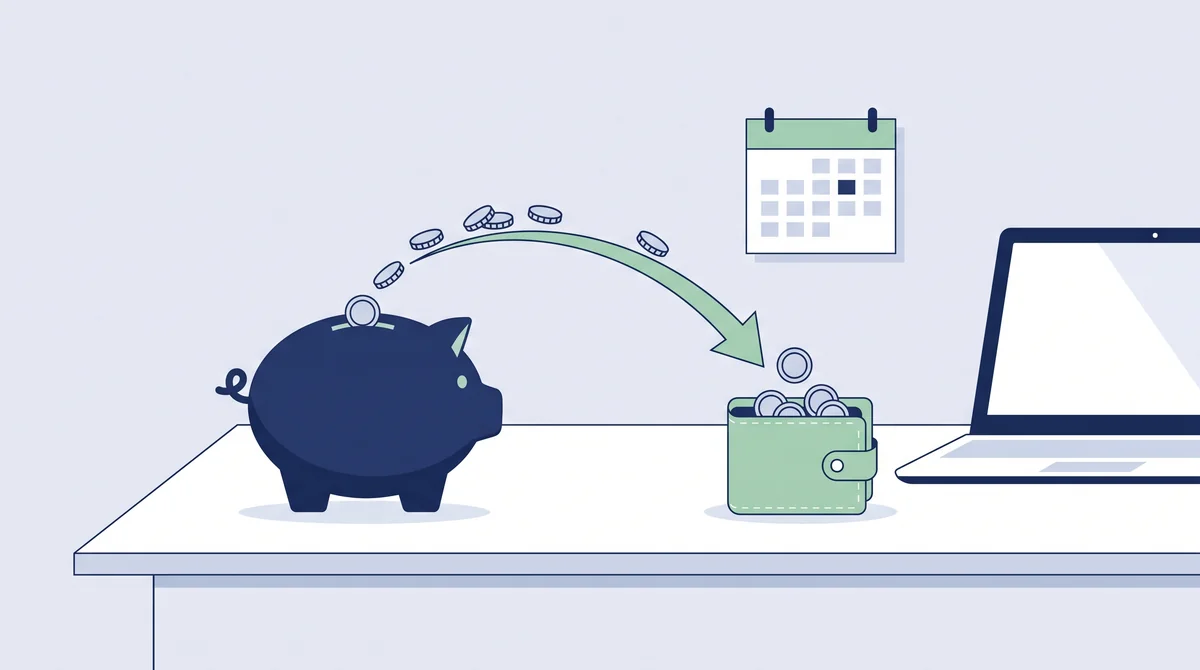
The short answer: as a sole proprietor (or single-member LLC taxed as one), you don’t pay yourself a salary. You simply move money from your business account to your personal account. This is called an owner’s draw. It isn’t a business expense and isn’t taxed when you take it: you’re taxed on your business profit, whether you leave it in the account or take it all. The trick is to pay yourself a steady, predictable amount and leave enough behind for taxes and slow months.
Can a sole proprietor pay themselves a salary?
No. A sole proprietor isn’t an employee of their own business, so you can’t put yourself on payroll or deduct a salary to yourself. Instead, the IRS treats your business profit, reported on Schedule C, as your income, and you pay income tax and self-employment tax on it (IRS).
Paying yourself a salary only becomes possible if your business is taxed as a corporation, for example an LLC that elects S corporation status. That has its own costs and rules; see LLC vs sole proprietor.
Owner’s draw vs profit: why the difference matters
This is the part that confuses new freelancers most:
- Your taxes are based on profit: income minus deductible business expenses, figured on Schedule C.
- Your draws are just transfers. They don’t reduce your profit and aren’t a deduction.
So if your business earns $72,000 in profit and you only transfer $50,000 to your personal account, you’re still taxed on $72,000. And if you transfer $80,000 (using money you saved from last year), you’re still taxed on $72,000.
Example: setting a monthly pay for yourself
Taylor is a freelance developer whose income swings between $3,000 and $10,000 a month. Over the past 12 months, Taylor’s net profit was $72,000, an average of $6,000 a month.
- Set aside taxes first. Taylor saves 25% of every client payment in a separate tax account: about $1,500 a month on average. Our guide on how much a freelancer should save for taxes explains how to pick your percentage.
- Keep a buffer. Taylor keeps two months of pay in the business account for slow months.
- Pay a fixed amount. Taylor transfers $4,000 to personal checking on the 1st of every month, no matter how much came in that month.
- Pay a bonus at the end of each quarter. If the business account is above the buffer after setting aside taxes, Taylor transfers the extra as a quarterly “bonus”: about $500 a month on average, or $1,500 a quarter.
| Monthly average | Amount |
|---|---|
| Profit | $6,000 |
| Set aside for taxes (25%) | −$1,500 |
| Regular monthly pay | −$4,000 |
| Left over (quarterly bonus) | $500 |
The result: Taylor’s personal budget runs on a steady $4,000 a month, even in a $3,000 month, and taxes are always covered.
How to pick your pay amount
- Look at your last 6 to 12 months of profit, not your best month.
- Subtract your tax percentage.
- Start your regular pay at 70% to 80% of what’s left, so a slow month doesn’t break you.
- Build a buffer of 2 to 3 months of pay in the business account before raising your pay.
- Review every quarter and adjust up or down.
If your income is new or very uneven, start lower. It’s much easier to give yourself a raise than to take money back.
Set up your accounts so it runs itself
A simple three-account setup:
- Business checking: all client payments arrive here and business expenses go out from here.
- Tax savings: your tax percentage moves here every time you’re paid.
- Personal checking: your monthly pay arrives here on a fixed date.
Read why a separate business bank account makes this so much easier. Many banks let you automate the monthly transfer.
Owner’s draws and quarterly taxes
Because no tax is withheld from draws, you pay it yourself through quarterly estimated taxes in April, June, September and January. Your tax savings account is where that money comes from. If you also have a W-2 job, you can cover some of your freelance tax through extra withholding instead.
What about a Solo 401(k) or SEP-IRA?
Retirement contributions are different from draws. They’re tax-deductible (except Roth contributions) and come from your business earnings. A good order of priorities each month is: taxes, then your regular pay, then retirement savings, then a quarterly bonus. See the 2026 limits in SEP-IRA vs Solo 401(k).
Common mistakes
- Taking whatever is in the account. A great month followed by a slow one leaves nothing for taxes.
- Treating draws as a deduction. They aren’t, and they don’t lower your tax.
- Paying personal bills straight from the business account. Transfer your pay first, then pay bills from personal checking.
- Forgetting the tax account. If it’s not set aside, it tends to get spent.
- Never adjusting. Review your pay at least every quarter.
How big should your buffer be?
The buffer is what makes a fixed paycheck possible. A simple target is two to three months of your regular pay, kept in the business account on top of your tax savings.
Using Taylor’s numbers: two months of pay at $4,000 is an $8,000 buffer. In a slow $3,000 month, Taylor sets aside $750 for taxes, adds the remaining $2,250 to the business account, and still transfers the usual $4,000. The buffer covers the $1,750 gap. In a strong $10,000 month, after $2,500 for taxes and the $4,000 pay, $3,500 goes back into the buffer or becomes part of the quarterly bonus.
If your buffer keeps shrinking month after month, your pay is set too high. If it keeps growing past three months, you can safely give yourself a raise.
Paying yourself when you also have a W-2 job
If freelancing is a side business, your salary already covers your personal budget, so you don’t need a monthly draw. Instead:
- Leave freelance income in the business account and set aside your tax percentage as payments arrive. Because your salary fills the lower tax brackets first, use a higher percentage than a full-time freelancer would.
- Move profit to savings or retirement on a schedule, for example once a quarter.
- Consider extra withholding at your job with a new Form W-4 to cover your freelance taxes, instead of making quarterly payments.
What changes with an S corporation
If your LLC elects S corporation status, you become an employee of your business. You must pay yourself a reasonable salary through payroll, with tax withheld, and you can take additional profit as distributions. This can lower self-employment-type taxes at higher profits, but it adds payroll costs, a separate business tax return and more rules. It’s a decision to make with a tax professional.
FAQ
Is an owner’s draw taxable? Not by itself. You’re taxed on your business profit, whether you withdraw it or not.
Can I deduct the money I pay myself? No. As a sole proprietor, payments to yourself aren’t a business expense.
How often should I pay myself? Monthly or twice a month works for most freelancers. The key is consistency.
Should I form an S corp so I can pay myself a salary? Possibly, at higher profits, but it adds payroll, a separate tax return and other costs. Talk to a tax professional first.
What if my business account goes negative after paying myself? Your pay is too high for your current income. Lower it, rebuild your buffer, and raise it again when your income supports it.
Sources
- IRS — Publication 334, Tax Guide for Small Business
- IRS — Sole proprietorships
- IRS — Estimated taxes
This article provides general information and is not tax, legal or financial advice. The example is simplified. Your situation may differ. Consult a qualified tax professional before making decisions.